
One of the nation’s few pipeline programs harnessing virtual reality to prepare students from historically underrepresented and under-resourced communities in STEMM for the careers of tomorrow.
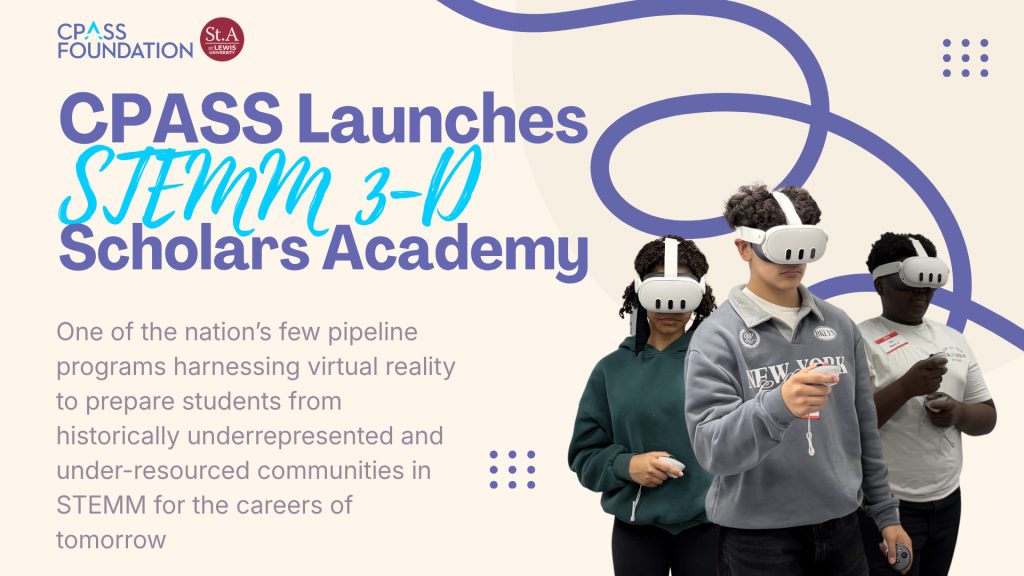
Imagine stepping inside a molecule, dissecting a virtual frog in three dimensions, or walking through the chambers of the human heart — all from your living room. For a growing cohort of 8th and 9th grade students across metropolitan Chicago, that is not science fiction. It is Tuesday afternoon.
The CPASS Foundation — the organization behind one of Illinois’ most storied science, technology, engineering, mathematics, and medicine (STEMM) pipeline programs — has officially launched the STEMM-3D Scholars Academy, a pilot initiative that places virtual reality headsets directly in the hands of students from historically underrepresented and under-resourced communities. The program is designed to do far more than dazzle — it is engineered to close the persistent opportunity gap that keeps too many talented young people from ever entering the science, technology, engineering, mathematics, medicine, and health workforce.
“For decades, CPASS and our predecessor program CAHMCP have been proving that when you invest deeply in young people from communities that have been left out of these professions, they don’t just succeed — they lead. The STEMM-3D Scholars Academy is the next chapter of that commitment. We are putting the most immersive learning technology available into the hands of students who deserve it most, because the STEMM jobs of tomorrow require us to prepare scholars today.”
— Dr. Eric E. Whitaker, Founder & Board Chair, CPASS Foundation
A Pipeline Program Unlike Any Other
The Creating Pathways and Access for Student Success™ Foundation traces its roots to 1979, when the Chicago Area Health and Medical Careers Program™ (CAHMCP) first began guiding underrepresented students from the streets of Chicago into the lecture halls of medical and dental schools. Nearly five decades later, that mission is more urgent — and more technologically ambitious — than ever.
The STEMM-3D Scholars Academy is one of only a handful of pipeline programs in the nation to integrate virtual reality as a core instructional tool for students from historically underrepresented and under-resourced communities. While many schools and enrichment programs are still discussing the promise of immersive technology, CPASS is delivering it — at no cost to scholars or their families.
Starting in April, the program equips scholars with a virtual reality headset and access to a robust, simulated reality platform, through which they engage with immersive, curriculum-aligned modules in math, science, and more. Scholars complete approximately 3–5 hours of self-paced learning per week, working through interactive simulations that make abstract concepts tangible, career-relevant, and genuinely exciting.
Learning in Three Dimensions
Research is consistent: students learn more deeply when they can see, interact with, and inhabit the concepts they are studying. STEMM-3D puts that research into practice. Rather than reading about cellular biology or solving equations on a worksheet, CPASS scholars step inside the material. Equations, molecules, biological systems, and scientific processes come to life in three dimensions — environments that mirror the actual settings students may one day work in as physicians, engineers, researchers, and innovators.
The program is built around three core features: immersive VR lessons, technology literacy training, and pre- and post-assessments to rigorously measure growth in student engagement, academic understanding, and STEMM identity. The assessments ensure that STEMM-3D delivers not just an experience, but a measurable impact.
An Entry Point to a Lifetime of Opportunity
What distinguishes the STEMM-3D Scholars Academy from a standalone technology program is where it leads. This pilot initiative has the potential to be the first stage of the CPASS STEMM Scholar Pathway — a multi-year journey designed to support students from early high school all the way through college graduation and into professional STEMM careers.
Scholars who complete STEMM-3D with strong participation and engagement are prioritized for acceptance into the CPASS STEMM Scholars Academy — a FREE, three-year, intensive residential college-prep program serving students in grades 10–12. There, scholars earn early college credit, participate in summer residencies on college campuses, develop professional networks, and receive the kind of sustained, holistic support that transforms aspiration into achievement.
For scholars ready to go even further, the pathway continues with CAHMCP, CPASS’s flagship post-secondary program, which has been preparing students in medicine from historically underrepresented and under-resourced communities for admission to medical, dental, and other health professional schools for more than 45 years.
Equity at the Core
The CPASS Foundation does not see cutting-edge technology as a privilege reserved for well-funded school districts. STEMM-3D is free to every scholar. Headsets are distributed directly. Technical support is provided. For scholars who have indicated that they are without reliable home internet access, CPASS is committed to connecting families with community access points and other solutions — ensuring that connectivity is never the barrier standing between a student and their future in STEMM. This pilot also gives CPASS a meaningful opportunity to fully understand and actively respond to the connectivity needs scholars and families bring to us. The program is designed to be completed from home, removing transportation barriers that too often prevent students from under-resourced communities from participating in enrichment programming.
This commitment to access is not incidental — it is the entire point. The STEMM workforce of 2035 will require millions of skilled professionals. The scholars who will fill those roles are in classrooms right now, in communities that have historically been overlooked by both STEMM employers and educational institutions. CPASS exists to change that equation, one scholar at a time.