
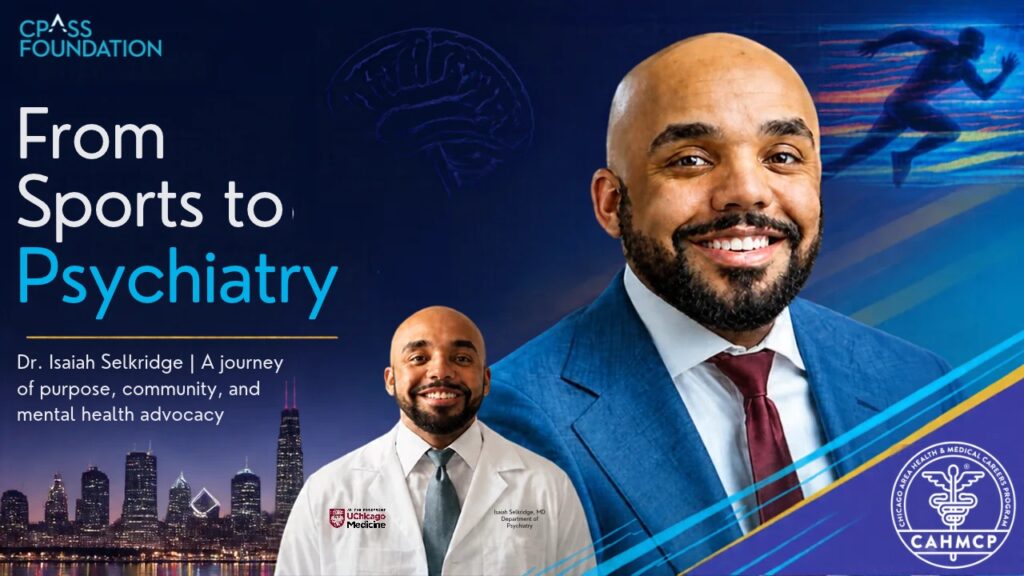
First year psychiatry resident at UChicago Medicine Isaiah Selkridge, MD, has always known he wanted to go into medicine. As the son of a former Olympian and an athlete himself, he spent years focused on a future in orthopedics. But in his last year of medical school, other life experiences steered him toward joining the 1 percent of practicing psychiatrists who are black men.
Born in the Bronx before Coming to Chicago
Dr. Selkridge was born and raised in the Bronx. His earliest memories of wanting to be a doctor came as he watched his uncle’s slow relearning of nearly everything after treatment for a brain tumor. His family tells him he expressed that he wanted to “know how to fix Uncle Stephen.”
Later, he attended a New York City high school with several children of physicians and became close with a friend’s father – a Black orthopedist – after he repaired a sports injury to Isaiah’s shoulder.
“I was scared about the surgery and what it meant for my career in baseball, and he took me under his wing. He invested in me as a teenager and we talked a lot about orthopedics,” he said.
“I wanted to be just like him, so from high school until my M4 year, I wanted to be an orthopedist.”
Further piquing his interest in orthopedics was Dr. Selkridge’s lifelong involvement in athletics. Isaiah’s father competed in track and field for Antigua at the 1988 Olympic Games in Seoul, South Korea, and instilled his love of sports in his children. Isaiah did “almost every sport imaginable growing up,” later focusing on track and baseball.
After completing his undergrad biology degree at University of Pennsylvania, Isaiah returned to New York City, where he spent five years at jobs ranging from the genius bar at the Apple Store to summer camp sports coaching to coordinating clinical research at the Icahn School of Medicine at Mount Sinai’s Tisch Cancer Center.
At Mount Sinai, Dr. Selkridge spent four years learning about research and co-authored several published journal articles. This helped prepare him for the University of Chicago Pritzker School of Medicine, which he started just before the Covid-19 pandemic began.
Mentorship in Medicine and Community Service
While in medical school, Dr. Selkridge connected with his closest mentor, UChicago Medicine emergency room physician Dr. Abdullah Hasan Pratt. Dr. Pratt, who goes by “Dee,” started a south side organization focused on violence prevention and response called MedCEEP, and invited Dr. Selkridge to lead sports initiatives for the group. He jumped right in, doing sports physicals for student athletes, providing sideline coverage at events, and holding student workshops on various health topics.
It was at MedCEEP that Dr. Selkridge was introduced to groups with overlapping missions, including the CPASS Foundation and Sneakers to Scrubs. He has stayed in touch with CPASS Foundation Associate Director, Tracie Screven, who encouraged him to continue showing up for Chicago youth and told him about CPASS programs for medical students and residents.
“It is just amazing every time I speak with Tracie and hear about the fantastic stuff CPASS is doing in STEMM. It’s so needed in Chicago,” he said.
“And knowing they help with STEP exams and the residency process created even more of an incentive to be involved.”
Dr. Selkridge received a grant for the Electronic Residency Application Service (ERAS) process, which covered not just application fees, but even the suit he purchased for interviews. He’s also currently enrolled in the STEP 3 test prep program at Kaplan through CPASS.
“Although I was a little late to the game with CPASS, the help has been awesome and I’m super, super grateful for it,” he said.
Changing Course
As he was doing rotations around his final year of medical school, Dr. Selkridge started getting rumblings about changing specialties after being single-minded about orthopedics for years. To help make his residency decision, he took take time off to do research at the Hospital for Special Surgery, a leading orthopedics center of excellence in New York City.
“I had to sit down and think about whether I really want to be an orthopedic surgeon. I felt great about my application, but not so great about my actual internal desires in doing it,” he said. “I realized that the time I spend talking to my patients and getting a complete picture of who they are was my favorite part of my rotations. It became very clear, especially through conversations with my wife and my brother, that psychiatry was something I should think more heavily about.”
One of the factors that led him to explore psychiatry was his brother’s experience overcoming major depressive disorder.
“I’ve seen him become such an amazing man, brother, son, husband, and more recently, father,” Dr. Selkridge says. “Seeing how therapy and medications changed my brother’s life so completely inspired me.”
Another factor was the picture of what life balance would look like after residency. Outside of God, Dr. Selkridge’s biggest priority is family, and he wanted to be present in his wife’s life and the lives of the children he hopes to have.
“Having a specialty that allows me to do really excellent things in my community and in the hospital while still having time to have an excellent home life was very important to me,” he said.
A third reason for choosing psychiatry is fighting the stigma that mental health still carries disproportionally in the Black community. He believes that having more Black psychiatrists, psychologists, therapists, and social workers can go a long way toward erasing that stigma and empowering the community.
As he explored the specialty, he learned there is more variety in it than he realized and hopes to experience the full breadth of the field through his residency, including not just inpatient and outpatient, but emergency, sports, addiction, and neuromodulation.
“I like to consider psychiatry surgery of the mind. As much as I enjoyed the technical nature of orthopedic surgery, I realized that what I love the most is going very methodically through someone’s life history and the choices they made to make them become the person they are today,” Dr. Selkridge said.
Becoming a Mentor
Dr. Selkridge is just coming around to the idea that he’s becoming a mentor rather than just a mentee.
“It takes me aback, then I remember I’m actually a doctor now and need to embrace it instead of being afraid of giving bad advice,” he says.
His advice for future Black doctors holds for just about anyone. First is that everyone should have non-negotiables to guide them when things get tough.
“And things will get tough! We don’t know how, but we’re all going to go through something,” he says.
For example, one of his non-negotiables is making time to watch LeBron James play. He schedules study time before and after a game but makes sure that he’s in front of a television when LeBron is on the court.
“Everyone should have something that they use to pour into themselves,” he said. “The saying that you can’t pour into others’ cups if yours is not full has a lot of truth in it.”
His next piece of advice is to embrace community for having fun, building a circle of support, and, importantly, giving back.
‘The biggest joy I’ve had in medical school is from giving back to my community – lifting as I climb,” he said.
Finally, he stresses the importance of keeping a focus on excellence as a means for making sure the first two happen. He explains that during medical school, he wanted to “do all the things,” but understood that he had to be choosy with how he spent his time to excel. He believes that by keeping non-negotiables, giving back, and maintaining excellence in your career, you can excel in all areas of your life.